What occurs when a brand-new innovation starts changing all your old presumptions?
We must be utilized to that question by now. We’re on our fourth or 5th go-round on it in my lifetime. This moment, it’s AI, however it’s been computers, and the internet, and smartphones and social media in previous waves.
Right here’s the lesson we need to hold on to: technology modifications, people do not David Mattin even named his newsletter after the concept: New World, Same Human beings , since it’s the lens where he watches every little thing
So, as AI starts biting on job we utilized to do, as it threatens our organizations and our audience approaches, what do we do?
We transform to our base mankind, and we consider exactly how we can offer basic human needs, that AI just can not do with anywhere near the very same efficiency.
We don’t demand information
Let’s be clear concerning this, uncomfortable though it could be: information is not an essential human need. Is it valuable? Yes. Does cultures function better with great, impartial reporting? Yes. Yet it’s not a need It’s a “nice to have”. Or, potentially,” extremely great to have.
So, what is the human demand that underpins information, and journalism more typically? It’s something we’ve forgotten, as we concentrate on the item– journalism– itself, without understanding the context within which that product operates. The requirement for information is underpinned by the requirement for connection , or maybe, community Without community, people do not thrive. With it, we come to be greater than we are separately.
We are fundamentally social animals. Isolation is connected with both mental and physical illness Arguably, it’s equivalent with cigarette use and alcoholic abuse as a hazard to your wellness From its very earliest days the net has actually been made use of as an expression of that extensive need, from e-mail discussion lists, to newsgroups, from online forums to blog site, and through right into social media.
Information as social things
News– communication concerning the social group– is an expression of the need for community. If you look back to the pre-digital kinds of posting, they were all, to a greater or lower extent, area focused:
- Profession press: specialist communities
- Local press: geographic communities
- Customer press: passion areas
- National press: political neighborhoods
We facilitate human social prospering via consuming details exchange.
Yet areas need something to collect around. We frequently call this the “social things” that goes to the centre of that neighborhood. If you look back at the history of journalism, as we simply did, titles that thrived tended to serve neighborhoods that gathered around specific type of social objects.
But the modern period provides us something more: the potential for journalism itself to come to be a social object. The oft-discussed “trip to particular niche” is simply an expression of digital promoting us serving extra targeted communities with the web’s capacity to permit us to locate others like us. We’re no longer depending on there sufficing people in a particular area for it to be rewarding for WH Smith (or must I claim TG Jones, these days ) to stock it.
If similar individuals can locate you via a search or social media sites, there’s the possible to build a material service offering them. And then to grow that relationship by not just serving them web content, but promoting connection between individuals because neighborhood.
The material dilemma
The difficulty, obviously, is that AI is starting to gnaw at the material services. AI can produce “material” much quicker and less costly than people can. The internet let loose an overall wave of human-created material, and that’s come to be a tidal wave with the development of AI-generated slop. Content is not the differentiator we believe it is.
The original wrong of the 2010 s was letting companies take neighborhood away from us. We offered the content, they provided the neighborhood tools. Turns out that the community tools were better, and people remained there, even as Facebook pressed a growing number of of our material out. (And, actually, permitted disinformation to have a level playing field with us.)
However we just absolutely have an audience when that audience feels they are in community with us, and we are with them. Rising media understands this much extra deeply than we do. They’re all “hi there, people” on YouTube, and chatting straight to the cam on TikTok, while we stand over all of it, with our neutral intonation and minor contempt for our visitors. Among the sources of our deep and expanding depend on issue with audiences is this: in a period where so much of the media they take in prioritises connection, neighborhood and personality, we so commonly go the other instructions.
Reconnecting with our target markets
And this is what we require to turn around. We can not pay for to have “regional” news reporters that have never ever been seen at neighborhood events in their spot because they’re ploding away at a difficult tale count target in some regional “content hub”. We can’t afford to keep mocking and mismanaging the remark area. Why? Since those tainted commenters are several of individuals who care sufficient about what we’re doing that they will make the effort to connect on our platform, rather than the countless social networks ones.
Not only that, however we require to accept that we do not have a right to exist, we need to maintain proving our worth repeatedly and once more per new generation, even as media shifts around us. And we can just do that by linking to the neighborhoods we serve.
And, as AI decreases the value of content usually, we can support the value of our journalism, by developing connections in between the people who produce it and individuals that consume it.
Serving your neighborhoods
Every journalist offers at a minimum two communities:
- The people they report on
- The people they report for
Sometimes, these are greatly identical. For example, in the profession press, the people you are reporting on are greatly the people you are reporting for It often tends to keep those journalists exceptional truthful and ethical because that overlap makes it really tough to get away with poor practices and still have an organization …
On the various other hand, they can be rather distinct. The nationwide information websites have a tendency to report on political leaders, service people and stars for a generalist audience. Too often, journalists prioritise their links with their resources– individuals they’re reporting on — over their links with their audiences, the people they serve.
We require to reset this alignment.
Material + Connection = Viable Organization
In an age where individuals can extract details (albeit of dubious precision) from AI chatbots, you require to provide more than just info to have a lasting service. You can do that by giving them context, analysis, and also point of view. However, for that to be reliable, you additionally need to win their count on– something we’re having problem with right now. And to reconstruct trust, we must restore connection.
The social systems ate our lunch in the 2010 s due to the fact that they used connection, and then let us pipeline our web content right into the link they would certainly let individuals develop. Building a toolset for connection ended up being much more powerful than providing the details that gas link because it speaks with the more profound need in mankind, rather than an expression of that demand.
What we now call “target market work” is really just a refocusing of journalism around what it constantly was: a service done for a neighborhood. I sometime use this phrase in my training and talking job:
Journalism is not an abstract art, it is a service attended to areas of interest, to improve their lives.
We need to completely take in that, and stop venerating information as an abstract value. It’s time to discover to ignore the seductive whispers of its high priests, the special, the angle, and the clickbait. And we require to spend much less time looking at our rivals for validation, and more time looking at our audience.
If we do this, many of the obstacles we face look much less intimidating.
Flighting the future with connection
We make it through “Google Absolutely no” by proving to our audiences that they do not requirement Google. Believe it can not be done? I have actually worked with one medical title who’s a considerable portion of their traffic coming straight to their scientific search page. They’ve developed connection and count on with their viewers over years and decades such that they will certainly go there first for the details they call for. And I don’t see AI rushing to hinder of that. “I asked ChatGPT, and it told me to use this medicine” will certainly not be a beneficial support in a clinical malpractice hearing …
We can start to depower dis- and misinformation by drawing our core audiences away from social systems, and into area areas under our control, where they can find both connection and the journalism that enriches that connection. Actually, this looks like a moral commitment at this moment, offered how liquid a vector the mainstream tech business’ platforms are for poisonous material.
And we make the human, fact-check, investigated nature of our journalism a function. No, more than that, a selling factor With count on in between our journalists and our audience, we become islands of quality link and information in a sea of economical content, shallow relationships and hazardous misinformation.
Reskilling the newsroom
This is a laborious. It needs bringing brand-new abilities right into the newsroom, ones we deserted over 15 years earlier. Yet, if you check out, you can see newsrooms doing this already. I had this screenshot in my slides for welcome week at City St George’s:
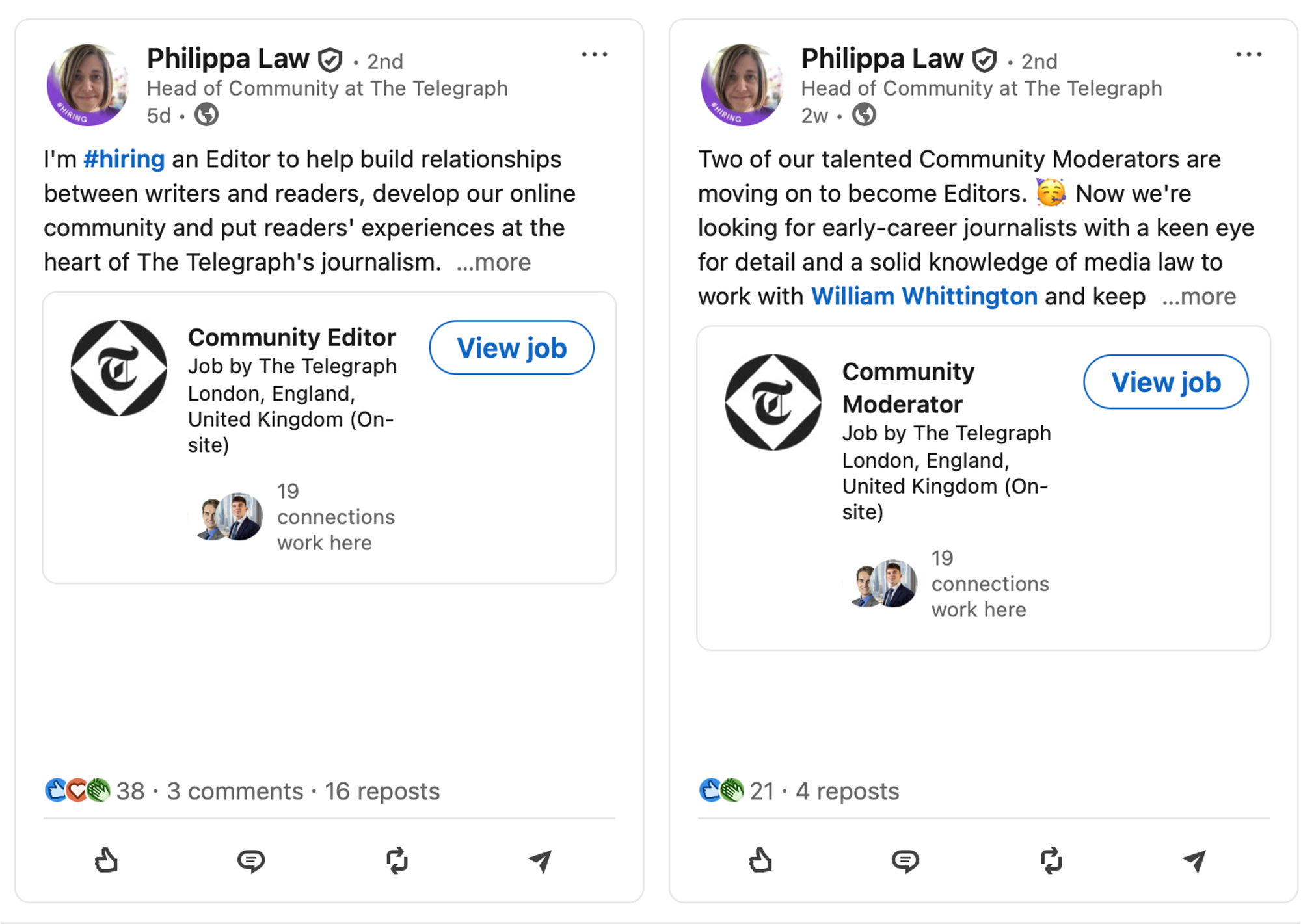
Why? To open their eyes to the reality that there are other means of doing journalism, and making that journalism matter, than the typical methods.
I’m significantly thinking about the 2010 s as the years of deception for our industry. After starting to adjust to the challenges of the net in the 2000 s, we pulled away to our comport zone in the adhering to years. We ended up expanding lazy regarding our partnerships with target markets, as the social platforms and the internet search engine fed us a consistent flow of soporific web traffic. However they have actually choked that off, and remain in the procedure of strangling what’s left.
We’re halfway via the 2020 s currently, yet there’s still time to make it the decade of reawakening and reinvention. We require to stop letting the winds of tech impact us off program, and set ourselves a company course, towards attached journalism, with audiences that trust us, and that see us as part of their area.
If we can get there, we can develop a stage for a brand-new renaissance of journalism in the 2030 s.